
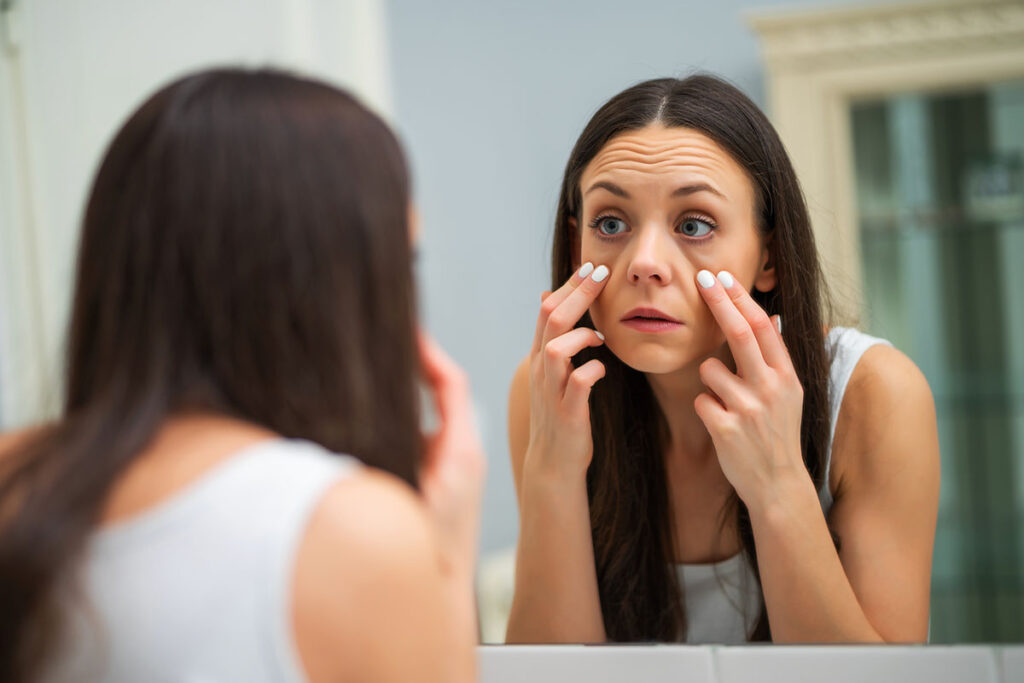
Under-eye bags are not a skincare problem. They are a structural one, which is why nothing applied to the surface has ever fully resolved them.
With age, the tissue that keeps the fat beneath your lower eyelid in place begins to weaken. That fat shifts forward, creating the persistent puffiness that looks like fatigue, regardless of how rested you are. Fine lines, skin laxity, and hollowing of the tear trough frequently develop alongside it. Lower blepharoplasty corrects the underlying structure rather than masking it, and the results are lasting precisely because of that.
What the Procedure Does
Lower blepharoplasty targets the excess and redundant skin, muscle, and fat beneath the lower eyelid, removing or repositioning what has shifted forward over time.
The preferred approach for most patients is transconjunctival blepharoplasty, where the incision is placed inside the lower eyelid and leaves no external scar. When skin laxity or fine lines are also a concern, a discreet incision just below the lash line allows Dr. Hochman or Dr. Tarabishy to address both in a single procedure. Fat repositioning can simultaneously correct the tear trough hollowing that often accompanies the bag itself.
The goal is a smoother, more continuous transition from the lower lid to the cheek. Natural-looking because it is structurally correct.
Who Is a Good Candidate?
Lower blepharoplasty is appropriate for adults in good general health with visible under-eye puffiness that has not responded to other approaches. It is not a procedure limited to older patients. Because the tissue holding orbital fat in place can weaken at any age, many patients present in their late 30s and 40s with fat herniation as their primary concern, well before significant skin aging is a factor.
Candidacy also depends on existing eye conditions, dry eye history, and overall facial anatomy. Our doctors evaluate all of this thoroughly during consultation.
Recovery and Results
The procedure is performed under local anesthesia with sedation or light general anesthesia and takes approximately one to two hours. Swelling and bruising peak within the first 48 to 72 hours and resolve substantially within one to two weeks. Most patients return to work and social activity within seven to fourteen days.
Results are considered permanent. The repositioned or removed fat does not return, and the structural correction holds. The face continues to age, but the bags do not come back.
Why Summer and Why Charleston
The recovery window fits naturally into a summer schedule. Within two weeks, most patients are socially presentable, and the results read simply as a well-rested return from time away.
A growing number of patients are making the trip to Charleston for this. At the Facial and Body Surgery Center, our doctors are board-certified surgeons whose practice is built exclusively around facial procedures. The surgical standard here is not a regional compromise, and the pricing reflects a meaningful advantage over major metropolitan markets. Telehealth consultations are available for patients who would like to get started before they travel. You can also review our facilities and the before and after results ahead of your visit.
Risks and Considerations
As with any surgical procedure, lower blepharoplasty carries risks including swelling, bruising, asymmetry, changes in sensation, and dry eyes. Patients with pre-existing eye conditions require careful evaluation before proceeding. Our doctors determine the appropriate technique based on individual anatomy and goals, and a thorough pre-operative consultation is the foundation of a safe outcome. Preparing for cosmetic surgery is a helpful resource for patients considering the next steps.
Ready to Start the Conversation?
If under-eye bags have persisted despite everything else you have tried, lower blepharoplasty is worth a serious look. Dr. Hochman and Dr. Tarabishy at the Facial and Body Surgery Center in Charleston offer telehealth and in-person consultations for patients considering this procedure.

